New Orleans school looks to ‘restorative justice’ to slow ‘school-to-prison pipeline’

A soft approach to school discipline at New Orleans’ Marrero Middle School is reducing suspensions and building relationships—a new dynamic after years of arresting and suspending students for bad behavior.

In 2015, Marrero Middle School drew national media attention when a Jefferson Parish 8th grader was arrested and handcuffed in front of his social studies class for throwing Skittles on the bus the day before.

According to The Atlantic:

The Skittles arrest drew national scrutiny. In response to the attention, the school district came up with a new discipline plan featuring restorative justice. The handbook now gives students the right to request a restorative circle before a suspension and offers schools guidance in how to use restorative techniques. The district also contracts with (New Orleans nonprofit Center for Restorative Approaches) to facilitate circles or train staff in restorative practices for any school that wants them.

In “restorative circles,” student caught fighting or breaking other rules or laws come together with a facilitator and parents to “repair the harm” through some sort of an agreement, a process Marrero principal Christina Conforto contends is more of a punishment than sending students home.

“Staying home for three days is an easy solution. That’s a vacation,” she said. “What is a harder solution is to sit there amongst your peers and their parents and your parents, and be made to take responsibility for what you did wrong. Being made to make amends, to have to make a contract, and have to apologize and shake hands in front of everybody? That is much more difficult than to stay home for three days.”

Since Marrero implemented the restorative justice approach in August 2016, suspensions at the school have declined by 56 percent, though Trout said the statistic is a side effect of the real goal of restorative justice.

“The goal of restorative practices is to create cultures and climates in which people feel connected to each other,” she said.

The process of building a stronger community at Marrero will undoubtedly benefit students and staff in ways they couldn’t predict.

James Davison Hunter, founder of the Institute for Advanced Studies in Culture and University of Virginia sociologist,  notes in The Tragedy of Moral Education in America that “The components of morality are expressed in a community’s institutions, including its moral rules . . .”

“When it functions well, our moral culture binds us, compels us, in ways of which we are not fully aware,” he wrote.

Marrero is putting in the hard and slow work of establishing moral rules in its school climate and culture by requiring students to take responsibility for their actions. Not only does it reduce suspensions, and possibly incarcerations, but also establishes norms and practices of making amends students are unlikely to forget.

Restorative practices are difficult, and success requires sustained, committed work. The Centre for Justice and Reconciliation offers a six-part tutorial to better understand the model used at Marrero.


Experts argue moral guilt ‘healthy, good to develop’ in children

A recent column in The New York Times explores the role of guilt in children, and explains how it relates to the way kids develop character virtues like empathy and kindness.

Pediatrician Perri Klass discussed how guilt—“a complicated element in the parent-child equation”—is a healthy part of child development that evolves as they grow.

Klass cited research by University of Toronto psychology professor Tina Malti, who argues that “moral guilt is healthy, good to develop.”

“It helps children refrain from aggression, antisocial behavior,” Malti said.

Malti explained young children can experience an empathic guilt for making another child cry, or for violating their own standards of right and wrong, and “those two reactions can be entirely independent, or can go together.”

Children generally develop beyond the simplistic version of guilt by age 6, when it becomes more about transgressions.

“There’s lots of evidence that healthy guilt promotes children’s prosocial behavior,” Malti said.

Helen Egger, chairman of the department of child and adolescent psychiatry at NYU Langone Health, told Klass guilt stems from “theory of mind” and it’s closely tied to a child’s empathy for others.

Egger said “children have to have developed a theory of mind, self and others, to be able to feel guilt.” On the other side, “when you have lying or lack of guilt, the child seems to have a reduced capacity for empathy,” she said.

Klass contends “guilt is part of children’s normal development, and we don’t actually want to see children grow up without it, but we also worry that they may judge themselves too harshly, or feel responsible for things that are well beyond their powers (the classic one would be the child who blames himself for his parents fighting, or even divorcing).”

Egger, Malti, and others highlighted the links between dysfunctional forms of guilt and depression and anxiety, and offered ways adults can identify and correct children to ensure they put their relationships and behavior in proper perspective.

The researchers highlight the natural and productive role of guilt to help youngsters internalize the values of society, a process that James Davison Hunter, founder of the Institute for Advanced Studies in Culture at the University of Virginia, discusses in broader context in The Tragedy of Moral Education in America.

In a critique of contemporary moral culture, Hunter writes, “. . . in the attempt to avoid the language of good and evil, the word guilt is effectively banished from this new vocabulary. People certainly feel guilty, but no one is actually guilty. Because we understand the mental and social causes of behavior, we know that wrongdoers are troubled, not guilty, and need therapy, not punishment. The goodness innate in them has not been properly brought out . . .”

Educators can explore the questions of guilt more deeply with students with lessons from the nonprofit Facing History and Ourselves, which offers a challenging assignment on guilt and responsibility in the context of the Nuremburg Trials.

“Using this lesson along with the documentary (‘Nuremburg Remembered’) will introduce teachers and their students to the essential questions of guilt, judgment and responsibility that were initially posed at the end of World War II and continue to be raised in the twenty-first century,” according to the Facing History site.

Principal uses own failure to improve school climate

Chicago charter school principal Isaac Castelaz is capitalizing on his failures to create a roadmap for success, a process that’s setting an example of strong character for his students and staff.

In a recent editorial for Education Week, Castelaz detailed how his first year as principal of National Teachers Academy, a public charter school, ended with a 5Essentials survey that showed his leadership left a lot to be desired.

Despite poor academic data, declining attendance rates, and increasing student suspensions, the results of the survey came as a shock, Castelaz said, and it sparked his commitment to design a plan of action that’s since changed the dynamic at the school.

“Dark red. Every essential was in the lowest category. The words hit me like a blow to the stomach: ‘Not Organized for Improvement,’” Castelaz recalled from his first year survey results. “The survey data, once I unpacked it, not only put lyrics to the sad song, but as any really great melancholy tune ought to, it helped me find hope: a roadmap to improvement.”

Castelaz spent the two months before the next school year changing how he approached his leadership position, spending 80 hour weeks working on professional development and creating a vision for the school year.

The principal worked to improve relationships with teachers in the building by listening, eating lunch together, hiring new staff, and designing new systems.

“I visited with staff before and after school to hear how the day went, or if they had anything on their minds. We monitored processes and systems consistently: Everything from attendance to whether lunch started and ended on time,” Castelaz wrote. “By establishing an organized culture, my staff felt less distracted and more comfortable focusing on teaching. In turn, the climate at the school was transformed. Staff felt valued, enhancing commitment and the quality of instruction. And students learned.

“We had a better year. Every data point said so. And when the results were released, the 5Essentials said so too.”

Castelaz demonstrated humility and courage in facing the failures of his leadership, and in doing so changed the singularly important dynamic of school climate in forming character in students.

University of Virginia sociologist James Davison Hunter explained that the moral culture of a school “is not merely the environment within which identity plays out.

“It is, even more, a reality that frames the categories of identity, structures the identity, and even indelibly stamps identity,” Hunter wrote in The Death of Character. “Without the authoritative presence of a moral culture, internalized into subjective consciousness, there can be no character or ‘character development.’”

A video on Vimeo provides more information about the 5Essentials survey and reporting tools that sparked Castelaz to take action.

The University of Chicago also hosts a Leadership Collaborative Series that helps school leaders “engage school staff in collective learning around leadership and targeted areas of the 5Essentials Framework, as well as combine knowledge and resources to create the conditions for school improvement.”

Dalai Lama calls for moral education for ‘a more peaceful planet’

The Dalai Lama believes schools should do more to promote moral education to move the world away from the “violent” and “sad” reality of the 2oth century.

“I think existing modern education is inadequate and it teaches more about materialistic pleasure and values. So when we grow up with modern education we go after power, money, and fame. Education should include moral education as an academic subject,” the Buddhist spiritual leader told more than 27,000 at the Kalinga Institute of Social Sciences in India, where he received the 10th KISS Humanitarian Award last month.

The international award, selected by a “high-level jury,” is designed to highlight people who make exceptional contributions in fields that tackle social issues.

The Dalai Lama said the last century was plagued with destruction, war, and mass killings, including deaths from the use of two nuclear weapons. The Nobel Peace Prize winner believes that by cultivating inner peace through moral education is the key to helping today’s youth reverse the trend and create a more peaceful planet in the 21st century.

“In this century . . . killing has become almost normal. This must change,” he said, according to The Times of India. “This century should be a century of peace. World peace can be achieved only through inner peace.”

The Dalai Lama’s invitation to make moral education central to education is worth heeding. Already, schools around the world are struggling to define moral education and how to integrate it into the curriculum.

Yet University of Virginia sociologist James Davison Hunter points out that curriculum is just one piece of a larger moral culture that extends beyond schools and into all aspects of human life.

“This moral culture not only gives us our ethical understanding, it also tells us who we are,” Hunter wrote in The Tragedy of Moral Education in America. “It provides us with an understanding of what it means to be human and what kind of human we should ideally be.”

A moral culture can make this explicit in classes, but it can also be woven into the ethos of a school, as it is in the Great Hearts Academies network of schools in the United States. Rather than making moral education an academic subject to give students a moral compass, this network of classical charter schools relies on its robust academic curriculum to weave moral formation into all of its instruction.

Cassie Mason, a teacher at Great Hearts, reflects, “What amazes me is that they [the students] really see the virtues that we talk about as something beautiful and something to strive for.”

Educators can learn more about Great Hearts’ approach to forming character with its Building Goodness by Building Character video.

“I think character and virtue are really the center of everything we do, because we are called Great Hearts, after all, not great minds,” said student Jack Fresqez. “And we’re encouraged to kind of question our actions, question everything we do, around whether it’s virtuous.”

“It’s not just about producing brilliant kids, but brilliant kids who have the character to deploy that talent for a good that’s greater than themselves,” said Great Hearts founder Daniel Scoggin.

Single-sex education: what’s old is new again

Education leaders are continuously on the lookout for a new method or technique to improve academic performance, or a way to create better schools. As The 74 reports, one of the latest school models shows that what’s old is new again: single-sex education.

“In the past two years, new single-sex charter middle schools have opened in Denver, Los Angeles, and El Paso, Texas. School leaders say having only girls or only boys makes their school communities feel like families, increases student confidence, and provides a safe place for students to develop their identities,” according to the news site.

Nick Jackson, founder of The Boys School of Denver, said he believes the single-sex environment benefits both genders because students are less concerned about being judged, and therefore more willing to speak up to build a community with their classmates.

“At a time in education where everybody’s looking for this magic silver bullet of what works and the pendulum is swinging back and forth, what we know works in education is really simple, right? It’s a simple solution to a complicated problem—it’s creating relationships, it’s establishing a sense of belonging. What these boys need more than anything else is, quite simply, love,” he said.

The Boys School of Denver, which launched this year with 90 6th-graders, is predicated on building a brotherhood where students can feel like they part of something bigger, Jackson said.

“It’s the missing ingredient in a lot of education. Once these boys feel (love), they feel like they are part of this team, this brotherhood, there’s no telling what they can accomplish,” he told The 74. “And that’s really what we try to do—we try to keep it simple that way. And the single-gender piece helps that: We can create that brotherhood—all the students are already coming in with one thing in common.”

The Denver school is part of a larger GALS charter school network, which also runs an all-girls middle school in Los Angeles called GALS LA. Carrie Wagner, executive director of GALS LA, said she attended an all-girls high school and can attest to the benefits of the single-sex education environment.

“I just got my voice at a very young age, and I never lost it,” she said.

Without the influence of boys, girls at GALS LA, which opened in 2016, often comment about how they can better express themselves and stand up to others at the school, Wagner said.

“There’s this whole idea of being ‘mean girl.’ There can be the mean-girl thing or there can be this amazing bond of sisterhood,” Wagner said, adding that “parents come up to me in tears” because they’re grateful for the positive environment at GALS LA.

“The feedback’s been amazing,” she said.

Single-sex education could also fill the bill of creating what researchers of the Institute for Advanced Studies in Culture refer to as a “thick culture.”

As Dr. Ashley Berner of the Johns Hopkins School of Education has said, “A strong school culture means something very different from a friendly school, or a high-achieving school, or a school with few discipline problems. Rather, it means a school where the moral vocabulary, rituals, discipline, academic expectations, and relationships align. Such a school can define its mission, hire faculty, and attract students and parents based upon a shared vision.”

Whether or not single-sex schools can deliver on their educational promises remains to be seen.

Moreover, critics see these schools as perpetuating gender stereotypes and inequities.

Nevertheless, it’s an indication of the possibilities available to public schools, both district and charter, as they seek to build a unique and thick culture that will form the intellectual and moral virtues of their students.

The time is now for citizenship and character education

Andre Perry, education researcher and founder of Davenport University’s College of Urban Education, believes “democracy is in deep trouble” and educators are the key to saving it.

“Educational leaders must take responsibility for instilling basic civic practices and virtues in their students immediately, or they may lose the option to autocrats who have other ideas on how to run a country,” Perry wrote in a recent editorial for The Hechinger Report, a nonprofit news site dedicated to inequality and innovation in education.

Perry pointed to Harvard lecturer Yascha Mounk, who said during an October gathering of political scientists that “if current trends continue for another 20 or 30 years, democracy will be toast.”

Those trends involve a push toward college and career readiness that seemingly ignores foundational skills students need to develop into good citizens with the ability to think critically, engage in democratic processes, and behave in a civic fashion.

Without foundational skills like social and emotional learning, citizenship education, and other strong character virtues, “the foundation on which education stands will crumble beneath it,” Perry wrote.

“An overemphasis on individual academic development and preparation for college and career has come at the expense of learning responsible leadership and learning for the benefit of social cohesion. To maximize our chances of getting a job or into college, we’ve separated learning into discrete components—academic, social, emotional—that when applied in narrow terms of college and career readiness defies how we actually live,” he continued.

Perry contends that the current individualistic, compartmentalized approach to education is working against the true purpose of education, which is to maximize individual talents for the good of democracy, citizenship, and social cohesion. There is a direct link between the education system and the fate of democracy, he wrote, and it boils down to how educators understand their role and their ability to instill foundational character virtues in students.

“People don’t live in schools or jobs; they live in communities. Schools and employers don’t transcend neighborhoods and cities; they are part of them. We can no more dissect and separate learning from our civic selves than we can disconnect individual talents from their public impact. The segregation of learning reflects that we educators have lost our purpose,” he wrote.

“Based on conventional measures, literacy is on the rise. But so are class inequality, incidents of hate as well as government attacks on basic civil liberties,” Perry argued. “We must primarily focus on our civic selves or our ‘solutions’ will continue to further divide us.”

The Vanishing Center of American Democracy,” a 2016 report by the Institute of Advanced Studies in Culture at the University of Virginia, supports Perry’s perspective, though the report notes that it’s not just schools that are struggling in their mission.

The Institute report noted “fear, animosity, distrust, and lack of comprehension that it fosters—is the common culture of early twenty-first century American democracy. It hasn’t helped that the mediating institutions directly or indirectly charged with political formation—schools, youth organizations, churches, and other institutions of faith, and local political parties—have weakened over the past half century.

“These institutions have failed to cultivate the shared civic sensibility at the heart of citizenship,” according to the report.

Educators who want to focus more on civic education and civic character in the classroom can look to places like the National Constitution Center, which offers lessons to help students examine the issues more closely.

In one assignment, “Citizenship and Character: Moderation, Finding the Balance,” students reflect on how the important virtues of moderation and self-discipline played into the founding of the United States by reviewing the Declaration of Independence, the U.S. Constitution, the Federalist papers, and other historic documents and applying it to their own lives.

Elon Musk insists that his kids learn moral character

Tech experts and industry leaders are calling for reinventing education to focus more on ethics and character formation, attributes they believe will be critical for the future.

And some are already taking steps to make it happen.

Business Insider recently featured a school created by Elon Musk for his five kids, Ad Astra, an ultra-exclusive, invitation-only institution whose name means “to the stars” in Latin. Musk told a Beijing Television station in 2015 that “there aren’t any grades” at Ad Astra because “it makes more sense to cater the education to match their aptitudes and abilities.”

Musk, the founder of Tesla Motors and the space company X Prize, has said little else about the school, which has no website or contact information, but X Prize Foundation chairman Peter Diamandis shared the school’s strong focus on ethics with the news site after a recent tour.

“One element that is persistent in that small school of 31 kids is the conversation about ethics and morals, a conversation manifested by debating real-world scenarios that our kids may one day face,” Diamandis wrote in a recent editorial for The Huffington Post titled “Reinventing our Kids Education.”

“Here’s an example of the sort of gameplay/roleplay that I heard about at Ad Astra, that might be implemented in a module on morals and ethics. Imagine a small town on a lake, in which the majority of the town is employed by a single factory. But that factory has been polluting the lake and killing all the life. What do you do?” Diamandis wrote.

“It’s posed that shutting down the factory would mean that everyone loses their jobs,” he explained. “On the other hand, keeping the factory open means the lake is destroyed and the lake dies. This kind of regular and routine conversation/gameplay allows the children to see the world in a critically important fashion.”

The focus on ethics and morals is one of numerous suggestions Diamandis offered to modernize and improve public education, but it ties in closely with other recommendations to develop strong character in students through a curriculum that bolsters their passions, feeds a mindset of persistence, and fosters empathy toward others.

Andrew Delbanco, a humanities professor at Columbia University, said in an interview that stories provide one of the best ways to teach ethics, which is fundamentally about understanding how to live with others.

Stories not only provoke reflection and self-criticism, but also expand students’ moral imagination, he said.

Herman Melville’s “Bartleby the Scrivener,” for example, “compels us to think about where our responsibilities for our fellow human beings begin and where they end,” Delbanco said. Literature in general, he said, pushes students to think about good character, and confront questions about right and wrong.

“I want to believe that by keeping such texts in the curriculum, and by pursuing the questions to which they lead, we’re provoking thought about matters that students might otherwise trivialize or evade,” Delbanco said.

The Jubilee Centre for Character and Virtues provides lessons for grade school through high school to help students relate literature to conversations about ethics, morals, and good character.

The lesson “Virtue, Vice and Verse,” for example, accomplishes exactly what Delbanco describes with a set of exercises “designed to challenge pupils to think about how the poems make them feel, and how virtues and vices are portrayed in each poem, or pair of poems.”

‘State of the Kid’ report: kids looking to parents as role models

A national survey of youngsters conducted by Highlights magazine suggests kids are looking for more from parents and other adults as role models, and it’s serving as a call to action.

The popular children’s magazine polled 2,000 kids ages 6-12 from across the country about their perceptions of kindness and other issues.

“We asked kids—the world’s most important people: What messages are they hearing from their parents and other adults in their lives about the importance of kindness?” according to the magazine’s “The State of the Kid 2017” report.

“Are they learning that adults value caring behaviors? Do kids witness their parents or other adults behaving rudely, and, if so, how does it make them feel? Does our next generation understand what it means to be empathetic?”

The results speak volumes.

The majority of children polled (68%) said they have watched their parents or other adults acting unkindly or saying mean things, mostly in the car (36%), on the phone (27%), and watching TV (24%).

Of those respondents, a total of 93 percent said they had negative reactions to the experience. Roughly half said they felt uncomfortable, while 43 percent were sad, 33 percent were scared, and just over a quarter were confused. Others were surprised, or angry, while small percentages were entertained, or felt safe or proud.

Highlights also asked students whether their parents think being happy, doing well in school, or being a kind person is most important. Forty-four percent of kids said their parents most want them to be happy, 33 percent said their parents want them to excel at school, while only 23 percent reported kindness as the top priority.

The data suggest that parents and other adults, the lead role models, could do better.

Research from the Institute of Advanced Studies in Culture makes it clear there’s a lot at stake, as family and the surrounding community play a crucial role in the lives and character development of children.

The Institute’s “Culture of American Families” report concluded:

In formation, it is the culture and the community that gives shape and expression to it that is the key. Healthy formation is impossible without a healthy culture embedded within the warp and woof of family and community.

The healthy formation requires parents and other adults to take responsibility for their failures, to encourage children to live up to the same high standards they hold for themselves.

Harvard University’s Making Caring Common Project offers an excellent starting point, with a list of parenting tips that can help parents take action to rebuild a healthy culture in their family and community.

How students are bridging divides with a hot meal

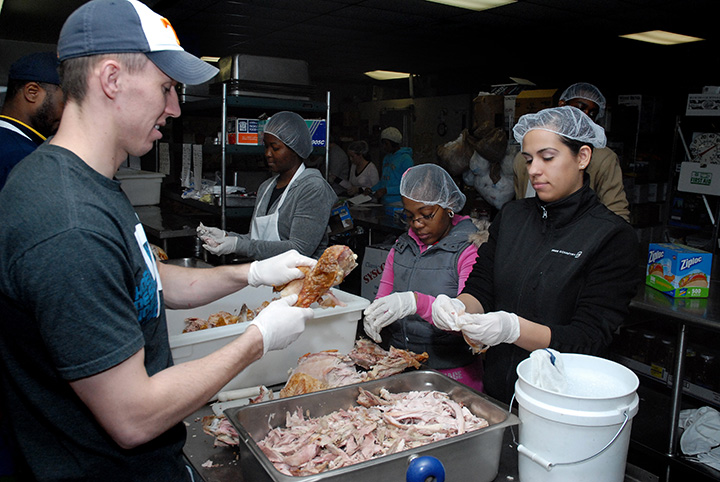
Students at Murrieta Mesa High School in California brought their community together, while helping those less fortunate with a massive Thanksgiving dinner.

Members of the school’s Interact Club continued a tradition of service by organizing the third annual “Share the Harvest” dinner for the Saturday before Thanksgiving, when about 1,600 folks from the community joined together to celebrate the holiday, Patch.com reports.

Interact Club faculty advisor Mike Stowe said the purpose of the event is to help the hungry, and to remind students why “serving others before self” is important. Stowe told the news site he “specifically designed this dinner as a community event” and it’s made a significant impact on students as it’s steadily grown over the last three years.

“In the three years that we’ve been here on campus and done this dinner, there’s been just a tremendous explosion of student programs for helping other people,” he said. “It’s always important; no matter whether it’s good times or bad times, there’s always people who need help.”

Several of the other student clubs also participated in this year’s event, including the Culinary Club, the Pink Ribbon Club, Leadership Club and USB. A flood of volunteers from community organizations like the Kiwanis Club and Rotary Club of Murrieta helped to make the dinner happen, as well.

A Rotary Club announcement of the event states roughly 700 people were fed in the event’s first year, and last year 1,100 were served. Organizers hope this year’s total hits 1,600, though an official count is not yet available.

Stowe said he hopes as many as 5,000 folks attend in 2018.

He credited help from the district’s food service staff, community businesses and churches, students, and generous donations from the school community for supplying food and manpower for a good cause.

According to Patch.com:

The donations included 120 turkeys from Abbott Vascular in Temecula and 250 turkeys from students, staff and parents of Murrieta Mesa High School. Other donations of cash or other items came from at least another 11 businesses and at least four churches.

Both Murrieta Mesa and Vista Murrieta schools held food drives, and the district’s food services department prepared the turkeys for the feast, cooking 100 birds at a time.

“It’s been an overwhelming outpouring of the heart from people to come out and serve,” Murrieta Mesa Principal Mary Walters told the news site.

Murrieta isn’t the only community reaching out to those in need. Ohio State University has hosted an annual Thanksgiving dinner since 1991 that serves as many as 1,600 guests per year, mostly international students who can’t travel home for the holiday.

In an age of “clicktivism” and campaigns to “end poverty” or other issues through donations to organizations online, gathering around tables with people from different walks of life is increasingly important.

Those meals provide opportunities to bond with each other and understand each other as people.

Philosopher James K.A. Smith explained in The Hedgehog Review, a publication of the Institute of Advanced Studies in Culture:

Charitable giving bent on fostering community has to be local. Whereas the technocratic machines of Big Philanthropy need to be as abstract as possible—hence the ‘global’—communion philanthropy can only be realized in particular places, with particular people, who share a place and a story.

The “Share the Harvest” dinner connects people who share a place and a story. It strengthens the fabric of the community by forming trust and relationships across education and economic gaps.

Teachers who want to connect similar practices of service with subjects like American history should consider lessons from What So Proudly We Hail, such as this discussion guide of George Washington’s “Thanksgiving Proclamation.”

Small towns struggle to keep football alive

The football team at North Dickinson County School in Michigan’s Upper Peninsula is going through changes, adapting to a new version of the game to preserve a community tradition that dates back decades.

The North Dickinson Nordics have dominated their conference, making it to the state playoffs for 23 years in a row from 1991 to 2013, but declining participation in the aging former lumber town forced school officials to make a decision: end its decades-old football program entirely or move to a smaller eight-player league.

North Dickenson officials resisted the move as long as possible, but ultimately opted to make the downgrade.

“Your football team is really on life support when you’re on eight-man, because there’s no place to go after eight-man,” North Dickinson Athletic Director Michael Roell told The Washington Post. “We’re hoping we can still have a football team for school pride, for homecoming, for all the things that should stay in high school.”

It’s a situation facing many schools in Michigan and beyond.

According to the Post:

As the game of football faces challenges nationally—head injury concerns, rising costs, sport specialization—the effects are being felt first and most acutely in small towns such as this outpost in Michigan’s Upper Peninsula. 

Michigan has lost 57 11-man high school football teams in the past five years, but most, state officials say, moved to the eight-player ranks. The state has poured resources into creating separate junior varsity leagues, varsity conferences and playoffs for eight-player teams.

Eight-player leagues are growing in other states, as well. The National Federation of State High School Associations reports enrollment for eight-player teams is up 12 percent since 2009, data collected before Washington, Wisconsin, and Hawaii added leagues.

At many schools like North Dickinson, the choice boils down to eight-man football, or no football at all.

Senior tight end Jared Miller said that after the departure of last year’s talented senior class, there weren’t even enough players to fill out an 11-man team.

“Nobody wanted to go, but nobody said anything bad about it,” Miller said. “It was this or nothing. We only would have had eight players on varsity.”

And while many folks at the school and other small towns across the country mourn the loss of football as they know it, eight-player leagues are providing a way to carry on a tradition that plays a critical role in the moral culture of their communities.

University of Virginia sociologist James Davison Hunter, author of The Tragedy of Moral Education in America, writes that “moral education can work where the community, and schools and other institutions within it [like athletics], share a moral culture that is integrated and mutually reinforcing.”

Maintaining high school athletic opportunities, even on a smaller scale, is important because “the difference a coach can make in a youth’s life is enormous,” according to Los Angeles Clippers coach Doc Rivers.

Rivers, who advises the Positive Coaching Alliance, contends that positive influence begins with “showing high school and youth coaches how to teach life lessons while preparing them to win on the scoreboard.”

The Positive Coaching Alliance provides a wide variety of resources for coaches to help students form good character through athletics, from training sessions to workshops to online courses and other tools.