UI students launch nonprofit to help disabled classmates navigate college

University of Iowa student Michael Penniman is changing the way disabled students experience college with the help of two friends and a nonprofit start-up they launched last year.

Penniman suffered an injury during a wrestling match with a friend in 2012 that left him a quadriplegic. After years of recovery that required him to relearn to talk and use his arms, he began taking classes at Des Moines Area Community College.

Two years ago, Penniman transferred to the University of Iowa as a sophomore, but he was often left stranded by the home health care companies he relied on to get out of bed and to class each day, the Iowa City Press-Citizen reports.

When his care providers missed shifts, Penniman reached out to his friend and fellow undergraduate Peter Easler, who eventually took over when Penniman’s regular caregiver broke her foot.

That’s when the two – along with another friend, Jacob Newcomb – hatched the idea to create a more reliable, student-run business to help their disabled classmates, while also providing a way for reliable college students to earn extra money.

According to the Press-Citizen:

Called Students Care, the idea is to use Medicaid waiver funds — which they hope to one day supplement with grant funding and other fundraisers — to pay students who perform home care in a more reliable and more personable way.

The startup is very much in the early stages. It is a registered nonprofit, with 12 employees, which they pay from $8.50 to $11 per hour. Other than Penniman, who himself is involved in the startup’s operation, they have one other client, a student at Kirkwood Community College.

Penniman, now a 25-year-old junior, trains new employees on how to meet clients’ needs, while Easler focuses on maintaining a high quality of care as they grow the business.

“That was the biggest thing for me for a while. Every day, I would ask, ‘How is this year compared to last year?’” Easler told the AP. “Because I don’t want to build something up if it’s not exceeding expectations.”

Newcomb said the concept of students helping students works well because it means help is always nearby, and the connections encourage disabled students to get more involved with UI’s activities and clubs.

In the book, The Death of Character, sociologist James Davison Hunter has highlighted research that shows that peer-to-peer service heightens the self-esteem among participants.  Not only is the founder of Students Care a person with disabilities, he has found ways to deliver his service in ways that show respect and establish new relationships.

“For college kids who aren’t disabled, its super easy to get involved in things,” he said. “We don’t want there to be any barriers for students with disabilities to go to a four-year university where they can enjoy it the whole time they are here.”

Teachers and principals interested in strengthening character formation in their school may find information and strategies at the UK’s The Jubilee Centre.

Sixth grader launches nonprofit to serve up compassion for the homeless

Marlon Miller Jr. is a Georgia sixth-grader on a mission, and he recently launched a nonprofit to take it to the next level.

Miller first learned about severe poverty when he watched his father give food to a homeless man six years ago, an experience that sparked a passion in the young boy that hasn’t waned since.

“We answered his questions and explained to him why some people live on the streets,” Miller’s mother, Tawanda Miller, told the Henry Herald.

It wasn’t enough.

For years Miller constantly pleaded for money for snacks and toiletry supplies to pass out to the homeless, but his mother couldn’t keep up with the demands. “I told him he needed to find a way to raise money on his own to purchase items,” she said. So that’s exactly what he did.

Miller, now in sixth grade at Union Grove Middle School, launched his own nonprofit last year called Deuce Hands, and he has held his first fundraiser – an ugly Christmas sweater party – in December. He also posted fliers at local businesses to solicit donations, and set up social media accounts for Deuce Hands to get the word out online.

“I knew he was serious when he came home with a list of homeless shelters,” his mother Tawamda said.

The 11-year-old uses the money raised to buy toothpaste, a toothbrush, soap, deodorant, water and snacks that he packages in what he calls “compassion bags.” Miller also employs his six-year-old sister Madison to help hand out the bags and volunteering at two events for the homeless each month, according to the Herald.

“I feel I’m lucky to be where I am,” he said, adding that he’s learned valuable lessons from the folks he’s met on the streets. “Homeless people really need help.”

This heartening story shows the influence of a father, the importance in finding one’s passion, and applying it to practical action. It is not an isolated story in urban public schools today. Researchers at the Institute for Advanced Studies in Culture found that effective urban public schools emphasized for critical moral ideas: 1. self-actualization, 2. grit, 3. respect, and 4. compassion. They state, “The moral framework and language for each of these tended to be a combination of solidarity for teachers and individual self-expression for students.”[1]

“We shouldn’t judge the homeless because they are usually good people who ended up in a bad situation,” Miller said.

Teachers and principals interested in strengthening moral formation in their students will find strategies and resources at the UK’s Jubilee Centre.

[1] Hunter, James Davison and Ryan S. Olson. The Content of Their Character (Finstock & Tew Publishers, 2018), p. 28.

College athletes visit MT schools to inspire students with messages about character, core values

Young students in Billings, Montana are soaking up lessons about character and leadership from college athletes they look up to – an initiative aimed at helping students visualize their goals becoming a reality.

The Billings Chamber of Commerce’s Champions of Character program capitalized on Montana’s first opportunity to host a national basketball championship – the 37th National Association of Intercollegiate Athletics women’s tournament – to connect Billings-area elementary students with the athletes they admire, the Billings Gazette reports.

In mid-March, players from each tournament qualifier attended school assemblies, read with area students and played a little basketball with youngsters while sharing the important elements of their success.

“We (asked players) to talk about hard work, character and the importance of education,” Billings Chamber of Commerce Communications Manager Kelly McCandless told the news site.

At Beartooth Elementary, members of the Cumberland University’s women’s basketball team were greeted with enthusiasm as they spoke with students about the values that guides their success.

Few things bolster a school’s moral ecology more than the example of positive peer role models. What makes this initiative so important is that it not only highlighted “cool kids.” But it did so in the context of discussions about specific core values. Researchers at the Institute for Advanced Studies in Culture found that “The schools seemed generally successful in creating a compelling moral environment and a binding moral order for their students… when students bought into the moral logic of the school.” Student buy-in is critical and this program only serves to enhance this dynamic.

“One by one, the team introduced themselves and explained five core values: respect, responsibility, sportsmanship, integrity and servant leadership,” KULR reports.

“Students in elementary school look up to pros and things like that and take their glorified position and not understand what it takes to get there,” Cumberland player Cydney Goodrum told the news site.

Athletes with the University of Science and Arts of Oklahoma, meanwhile, met with students at Ben Steele Middle School to offer inspiration.

“It’s really cool to see many younger kids wanting to get involved and play,” Oklahoma athlete Becca Worthy said. “We were there once and it’s really cool to see high school and college kids come and show that it’s possible to be where you wanna be and follow your dream, if that’s what you want to do, you can make it happen.”

A total of 3,000 college athletes participated in the NAIA tournament, many stopping in at other Billings schools including Big Sky, Poly Drive, and Highland elementary schools.

For teachers and principals interested in student moral and character formation, information can be found at the UK’s Jubilee Centre website.

Elite mountaineer designs adventure-based experiential learning

The U.S. Air Force Academy’s Lt. Col. Rob Marshall is leading a new way of forming character in young cadets that’s pushing them out of their comfort zones and forcing them to apply what they learn in the outdoors.

“There’s not a single cadet here who isn’t highly intelligent, but how far have they been tested?” Marshall questioned. “Learning with unpredictability is essential and that’s what Mother Nature provides.”

Marshall graduated from the Academy in 2001, and he’s since climbed to the summit of the tallest peak in every continent as a primary lead for the Air Force Seven Summits team. He’s also a CV-22 Osprey pilot who has transported special operations soldiers in and out of war zones, according to an Air Force feature.

Marshall now works as the director of experiential education for the Academy’s Center for Character and Leadership Development, where he’s devised a new 10-day program for the cadets’ Expeditionary Survival Training. The program, slated to start this summer with 1,200 sophomore cadets, is designed to encourage them to push through their personal limits to innovate in a real world setting—a process that shapes character.

“In the classroom, we mainly learn through reading, discussion, watching and listening,” Marshall said. “Experiential learning involves applying the concepts learned in the classroom—often outdoors—experimenting with them and sometimes failing.”

The new training will involve a 12-hour hike, followed by a 24-hour hike, and will culminate with a 36-hour adventure race through the wilderness near the Academy’s campus, north of Colorado Springs, Colorado.

“At the end of each experience, cadets will debrief and reflect upon what they learned,” Marshall said. “This way the experience is personalized and they can then try it again and again, each time learning something new and hopefully improving their results.”

Col. Mark Anarumo, head of the Center for Character and Leadership Development, said the goal is to document the success of the new approach to forming character in cadets, in hopes the Air Force will implement the same style of learning in other areas. “We will push them to their personal limits through these programs and test them in ways they would otherwise never experience short of leading in a combat environment,” he said.

James Davison Hunter and Ryan S. Olson, with the Institute for Advanced Studies in Culture at the University of Virginia, note in The Content of their Character:

There is a fundamental principle about the formation of identity: Who we are is, in part, a function of who we are not. As individuals and groups, we define ourselves against something else.

The new program at the Air Force Academy defines itself against the status quo of teaching to a test in a controlled environment, and the plan to expand the approach is a testament to a broader shift in character formation.

“I believe the number one skill that we have to fight our enemies is innovation and the outdoors requires innovation in abundance as the rules and environment are always changing,” Marshall said. “I want our cadets to realize that when you walk off the beaten path you’re no longer following the status quo and that’s okay, because often the status quo is our enemy.”

Outward Bound, a program for students ages 14–17, takes a similar approach with expeditions that “push students physically, socially and emotionally.”

“Often when they think they’ve reached their limits, they find there is more within them,” according to the nonprofit’s website.

Navy Leadership Development Framework focuses on character

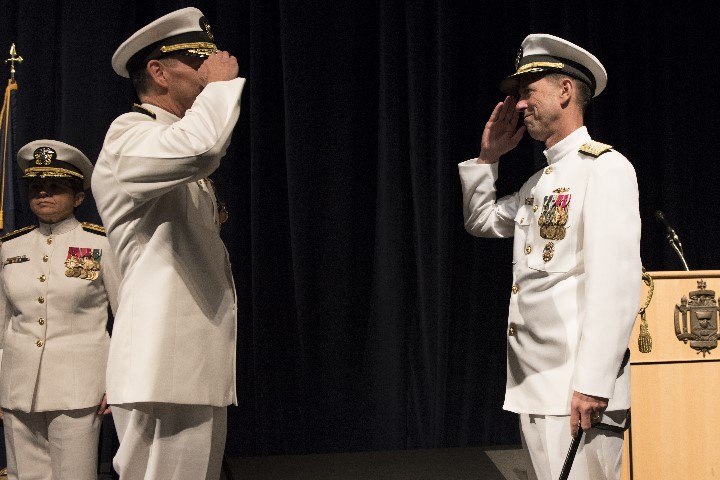
The U.S. Navy’s success at defending America and maintaining maritime superiority in a quickly evolving world centers on developing competent leaders with strong character—the central focus of a new Navy Leader Development Framework.

The framework, which all sailers are expected to review and embrace, outlines “how the U.S. Navy will develop leaders that demonstrate both operational excellence and strong character at every level of seniority,” according to USNI News.

Chief of Naval Operations Adm. John Richardson recently released the document to explain how the goal—leaders with strong character—requires “two lanes on the path” to excellence. “Lane 1 develops operational and warfighting competence. We must become more skilled at our jobs as we grow. An incompetent leader is a recipe for disaster,” according to the framework. “Lane 2 develops character. We must strengthen our ability to always behave consistently with our core values of honor, courage and commitment.”

And the Navy’s process of character formation isn’t restricted to the classroom.

“In our Navy, leaders can take full advantage of a rich combination of formal schools, structured on-the-job training and experience, and self-guided education,” the framework reads. “Every day top leaders take the opportunity to put into practice what they learn.”

“Character applies in an operational setting—it’s not just for the classroom. The best leaders mention it at briefs, during execution, and during debriefs,” according to the document.

The character development framework also involves mentors who demonstrate both technical knowledge and operational skills through drills and routines, but also the strong character necessary to develop leadership.

“Mentors do all of the above, and more, in a way that is more personal, involved, and long term,” according to the framework. “Mentors probe deeply into their protege’s strengths and weaknesses, challenging them to be a more complete ‘whole person.’”

Richardson’s directives resonate with school-based research recently published by the Institute for Advanced Studies in Culture.

James Davison Hunter and Ryan S. Olson write in The Content of Their Character:

[C]haracter is constituted by the enactments of the moral ideals espoused within a tradition and enacted within the institutions of particular communities . . . These virtues are, more often than not, valorized in a society’s social institutions and celebrated in those exemplars who practice them well.

The Navy, an institution with a strong command structure, has the opportunity to actively push its leaders to build character. And while schools and other institutions are tempted to focus merely on competence, the Navy’s new framework contends that “Competence and character are so tightly intertwined that they must be strengthened together.”

School leaders with the same perspective can look to the U.S. Army Junior Reserve Officers’ Training Corps (JROTC) to provide similar programs that develop leaders with strong character in their school.

Austin, TX increases access to Garcia boys school

School choice debates are often framed around competition; public district schools vie against public charter schools and private schools to enroll students. However, in Austin things look a little different. The public district celebrates the variety of schooling options available to parents, including Gus Garcia Young Men’s Leadership Academy.

Last week, the Austin Independent School District announced their plans to provide transportation for any student wishing to attend Gus Garcia Young Men’s Leadership Academy. The announcement was made at a press conference, which the Austin American-Statesman covered.

The school is a all-boys campus serving grades six through eight. Artist Tyson, an 8th-grade student, was invited to speak at the press conference. He told the audience that Garcia’s single-sex composition was a major factor in its unique value.

“Something we get that you don’t obtain at other schools is brotherhood. The teachers here are phenomenal, but they are not our only educators. Our brothers teach us,” said Tyson. As a single-sex school, its culture and curriculum are tailored to its students. And, like other schools that families choose, it reaps the benefit of buy-in from that selection process.

The Austin district is eager to capitalize on this successful initiative. The school has room to grow in its enrollment, and officials are expecting that the decision regarding transportation will increase the number of students in attendance by at least 120. With enrollment currently at 400 students, this would represent growth of 30%.

Tyson is an example of a student whose family was so drawn to the mission of Garcia that they moved into the district just so he could attend. He summed up the trajectory that the school strives to move students through: “Boys yesterday. Men today. Leaders tomorrow.”

The school’s focus on developing students as young men, as well as scholars, clearly resonates. Sterlin McGruder, Garcia’s principal, said he regularly spoke with parents who wanted to enroll their children if not for the issue of transportation.

Now, thanks to the efforts of the Austin Independent Schools District, more students will benefit from the unique and holistic culture that exists at Garcia.

The Institute for Advanced Studies in Culture at the University of Virginia conducted an extensive field research project in ten sectors of American secondary education. This field research included “pedagogical schools,” which Notre Dame sociologist David Sikkink, writing in The Content of Their Characterdescribes as “attempts to realize a full-orbed vision of education that [includes] a guiding mission or philosophy and fairly precise guidelines for school structure and teaching methods.”

Gus Garcia Young Men’s Leadership Academy has just such a defining mission:

In an environment of brotherhood, the Gus Garcia Young Men’s Leadership Academy develops scholars who are empathetic, service-oriented problem-solvers—lifelong learners who succeed in high school, college, career and life.

Tyson also noted that he is “surrounded by positive influences, particularly by men of color” and is taught to be a leader.

Education Week provides an interactive snapshot of the location of public single-gender schools for interested parents and educators. As it turns out, Gus Garcia operates in the state with the most single-gender schools.

Lutheran school builds leaders through student council

Many students at St. Paul’s Lutheran School have a natural inclination for leadership and responsibility, and a move to start the school’s first student council is providing formal opportunities for them to apply their skills.

First-year principal Larry Wooster told the Pilot-Tribune & Enterprise that teachers suggested the idea and created an application process that required students to fill out paperwork and gain approval from their teacher. Selected students crafted posters and campaigns, and gave speeches to their classmates, who voted for a president and vice president, secretary, and a representative for 3rd/4th, 5th/6th, and 7th/8th grades.

“One of the fears with something like this is it becomes a popularity contest and we tried to not make it that,” Wooster said, adding that he believes students voted wisely. Jamey Rhea, an 8th-grader and new student council president, is a good example, he said.

“He has always been a good leader, but I don’t know if he’s had the opportunity to use that leadership in a formal environment,” Wooster said. “It gives him more structure and the opportunity to practice leadership skills he already has, but in a different way.”

Rhea is joined by vice-president Emma Misfeldt, secretary Carisa Brazelton, 7th/8th-grade rep Luke Hammang, 5th/6th rep Brooke Hilgenkamp, and 3rd/4th rep Erika Krusikshank, according to the news site.

“If [the faculty] had chosen representatives, these are probably the students we would have chosen,” Wooster said.

The principal said the group is already off to a good start, helping take on projects that were previously left to teachers. The students have also organized special dress up days and the school’s Lutheran Schools Week celebration in January. “We had a pretty big hand in the Veterans Day ceremony,” Rhea said.

Wooster said students have already gained valuable experiences through public speaking, organizing, and working together, and he believes the group’s creativity will eventually help tackle issues outside of school.

“I’d like to see them come up with suggestions for new playground equipment and service projects,” Wooster said. “They may come up with service projects we have not thought of that would give them the opportunity to serve the community.”

St. Paul’s new student council mirrors the approach of pedagogical schools studied by David Sikkink, whose findings appear in The Content of Their Character.

Editors James Davison Hunter and Ryan S. Olson, with the Institute for Advanced Studies in Culture, noted that these schools “teach character and citizenship through experiential learning opportunities such as ‘town meetings,’ student government, grade-level meetings with administrators, and practices that fostered mutual commitment to every student’s success.”

St. Paul’s is a school that rests on its religious foundation, while also incorporating elements of pedagogical schools that allow students a formal venue to practice leadership and encourages their desire to improve their school and community.

“I wanted to help the school before I leave for high school,” vice-president Emma Misfeldt said.

The National Association of Student Councils (NatStuCo) provides a framework for student councils to develop civic action plans that clearly define community needs, action recommendations, and action steps, as a way for leaders like the students at St. Paul’s to make their schools a better place.

Summer school prepares Jewish students for leadership

A Yale University summer school is helping Jewish students who do not attend Jewish schools to study how their faith plays into a variety of issues—from public policy to economics, history and statesmanship—in a bid to cultivate young leaders.

Over the last six years, the Tikvah Institute for High School Students has hosted juniors and seniors from Jewish schools at Yale’s campus in New Haven, Connecticut, and this year the summer school is offering classes specifically designed for Jewish high-schoolers who don’t attend Jewish schools.

The new Maimonides Scholars program is sponsored by the Maimonides Fund, a Jewish philanthropy organization, according to the Jewish Standard. The Maimonides Scholars program is an addition to the current Tikvah Scholars program, which caters to Jewish students who attend Jewish day schools.

Former Orthodox Jewish school principal and Tikvah Institute dean Rabbi Mark Gottlieb explained that the new Maimonides Scholars program isn’t designed to promote a particular view of Judaism, but rather to cultivate leaders outside of the traditional Jewish school system.

“We aim to reach these students where they are, showing them the sophistication and beauty of Jewish thought in a nondenominational way,” he said. “We will have teachers representing different denominations, and students won’t be expected to adopt Orthodox practice. We don’t intend to convey an exclusive or monolithic view of Judaism. When students are exposed to Jewish texts and ideas that speak to them, we expect they’ll grow closer to Judaism, wherever they are in their practices and beliefs.”

The intent, he said, “is to train these students to take on leadership positions in the Jewish community on campus and beyond, by teaching them a broader base of knowledge and wisdom through history, politics, and philosophy,” Gottlieb said.

The Jewish Standard reports:

While the Tikvah Scholars and Maimonides Scholars sessions will be separate and geared to each cohort’s educational background, there will be integrated experiences, including a debate workshop. Both cohorts will be provided with kosher cuisine and a choice of non-mandatory Shabbat options for prayer, meditation, and study.

All 120 students are urged to “see each other as real allies in the struggle to represent and live their Judaism in a deep, sophisticated, and proud fashion, building up to the time when they arrive at college together,” Rabbi Gottlieb said.

In essence, the summer school, as a whole, draws out the unique strengths and contributions of Judaism in a way that is not “an exclusive or monolithic view of Judaism.”

James Davison Hunter, founder of the Institute for Advanced Studies in Culture, in the final chapter of The Death of Character offers this hopeful word regarding the kind of work that the Tikvah Institute is pioneering.

Creating space in this way for different moral communities to flourish in public and private life might very well lead to conditions that are conducive to the growth of people of good character . . .

That certainly bodes well for the students accepted to the Maimonides Scholars program—and for the schools to which they will return in the fall.

Jewish families can find out more about the Maimonides Scholars program, which runs from June 24 to July 8, 2018, on the program’s website.  Applications are available online, and the deadline to apply is February 16, 2018.

Leadership academy will thrive on partnership

Business leaders in Wisconsin have offered to help fund a leadership academy that would “develop a servant leader-minded workforce.”

Festival Foods Board Chairman Dave Skogan asked more than 50 business and community leaders and high school superintendents in the Coulee Region for pledges totaling $600,000 to pay for a character-building curriculum.

The Character Lives curriculum arose from a 2013 survey in which more than 700 employers said they had trouble finding recent grads to hire because, although technically competent, the applicants lacked adaptability, as well as the communication, decision-making, and problem-solving skills needed for the job.

Character Lives brought in John Norlin, co-creator of the CharacterStrong curriculum on which Character Lives is based, to introduce students to the concept and to train teachers. Part of the $600,000 will be used to pay Norlin, a Washington state-based motivational speaker, whose goal is to train 120 teachers before May.

Research shows that if schools teach students only for test scores, they will learn only one-third to one-half of what they need to know, Norlin told the Wisconsin community leaders. He said students can engage in five different conversations on six different platforms on a cell phone, but many are lost when it comes to face-to-face conversations.

“If you ask them to meet someone and talk, it’s like a death sentence,” he said.

Norlin said Character Lives teaches students to relate to each other and develop character, the foundation for improving the community and the world. The idea that leaders are born and not made applies only to a few and lets everyone else off the hook, he said. “We all have skin in this. Personality is a gift. Character is a habit.”

Can an initiative such as Character Lives make a difference in the lives of students? Possibly, answers Institute for Advanced Studies in Culture founder James Davison Hunter, in The Tragedy of Moral Education in America. “[E]vidence suggests that character education programs can work better if children work and live within a moral culture that sets boundaries and offers ideals and makes the moral demands seem to be the way the world is.”

The public-private partnership represented in the proposed leadership academy is one way to help set those boundaries and offer ideals, such as that of servant-leadership for young people.

The Character Lives website, where teachers can learn more about the program, says, “Schools can’t do it alone.” They’re right. It is always the work of a community.

Club teaches boys to lead in positive ways

Administrators at Illinois’ Quincy Junior High School are working with 6th-grade boys to give them the “skills to make a man valuable and character to make a man invaluable,” The Herald Whig reports.

“They’re men in the making—and what they learn now, along with how they act, can help them move into the future confident and capable,” according to the news site.

QJHS Principal Dan Sparrow explained how the idea to help guide the school’s boys into adulthood began when he noticed assistant principal Rick Owsley and “a couple of kids during lunch . . . outside weeding, picking up things.”

“He saw an opportunity that they kind of wanted to give back to the school, taking some pride in it,” Sparrow said.

In December, several 6th-grade boys met up with Owsley to launch the school’s first Men in the Making Club, which teaches life skills and character virtues highlighted in the best-selling book Manual to Manhood.

Students were required to get written permission from their parents to attend, during advisory periods or lunch, and discuss the issues they face as they grow into men.

“Moving from boys to become men is hard,” Sparrow said. “With that comes responsibility.”

Sixth-grader Chase Lawrence said he signed up because “it sounded like fun, interesting and a great time.”

“Plus, people can talk to us, help us,” he said.

Students who join receive a gift box with a book and T-shirt, which Sparrow asks the boys to wear on Fridays to show their pride. Lunchtime discussions center on issues like respect, and building a “social-emotional bank account” to use at school.

“How do you get respect? It’s not given. You’ve got to what?” Sparrow asked students.

“Earn it,” the boys said, according to the Herald Whig.

Sparrow said he wants the students to understand that the way they project themselves—whether they do their homework, how they treat teachers and classmates—impacts their character, and their ability to lead.

“People are going to look at what we do, how we behave, how we act, the things we say,” Sparrow said. “The biggest part of that’s trust. You’ve got to have the trust of people, then you will earn the respect.”

Sparrow said the goal is to build strong character in students that will ultimately draw others into the club and its positive mindset.

“Sometimes students lead in positive ways. Sometimes they lead in negative ways. If we convince the negative leaders to lead in positive ways . . . when we start doing this together, start growing this, then we truly can make junior high what we all want it to be,” Sparrow said.

The QJHS Men in the Making Club fills a critical role in character formation and moral education.

James Davison Hunter, founder of the Institute for Advanced Studies in Culture at the University of Virginia, wrote in The Death of Character that morality “is received by the individual, internalized into subjective consciousness, and thus experienced as the basic ordering of categories of life.”

Sparrow is providing the vision of responsibility for young men at his school through intentional practice and regular guidance.

Jonathan Catherman, educator and author of Manual to Manhood, offers a framework for building clubs, as well as a guide to get started.