Missouri teen refocuses on character in high school to earn appointment to U.S. Air Force Academy

Republic High School senior Noah Johnson described himself as a lost “troublemaker” in middle school, but he’s transformed his character over the last five years to forge a different path.

“Before high school, I was not the best student. In eighth grade, I decided to turn my life around,” Johnson told the Springfield News-Leader. “I realized I had potential to do things, to go places, if I just tried. I came to the high school with the mindset that I needed to start fresh.”

This transformation began with a decision, was surrounded by encouragement, and focused on a goal. Noah is seen as stepping into a larger story and this is crucial for character development. James Davison Hunter, founder of the Institute for Advanced Studies in Culture, writes in The Tragedy of Moral Education in America, “Implicit in the word character is a story. It is a story about living for a purpose that is greater than the self. Though this purpose resides deeply within, its origins are outside the self, and so it beckons one forward, channeling one’s passions to mostly quiet acts of devotion, heroism, sacrifice, and achievement.”

The Missouri teen joined the Republic High School Junior Reserve Officer Training Corps (ROTC), and focused on his studies. His humble dedication earned him recognition as outstanding first-year cadet.

“After that, we knew the potential was there,” Lt. Col. Patrick Sanders, head of the Republic ROTC, told the news site.

“I’d give him a job to do as a sophomore and he’d need a little guidance. His junior year, he’d just do it. By the time he was a senior, he didn’t even need to be told,” Sanders said. “You name it, he’s grown in all the areas — maturity, leadership, behavior. It’s huge growth.”

Johnson’s grades improved, as well, and he earned a 32 out of 36 on his ACT. He also played snare in the marching band. When it came time to apply for colleges, he set his sights on the U.S. Air Force Academy, knowing only one in 12 applicants receive an appointment, and even fewer from small rural public schools.

“That seemed like a challenge and I’m up for a challenge,” Johnson said. “I thought, ‘I’m going to try for there.'”

The Academy reviewed Johnson’s grades, activities, fitness, leadership and character, as well as nominations he received from U.S. Rep. Billy Long and U.S. Sensators Roy Blunt and Claire McCaskill as the senior waited to hear back, the News-Leader reports.

Johnson’s family and counselors encouraged him to apply to other schools, as well, and he earned full-ride scholarships to several. But his family’s history of military service and interest in aviation made the Academy his top pick.

“If you want to be a pilot, one of the first things you look at is the Air Force,” he said. “The prestige of going to the academy interested me.”

A year after starting the application process – five years after refocusing his life – Johnson received word that he was selected for an appointment, a value of more than $400,000 that includes tuition, room and board, medical, and a monthly stipend, according to the news site.

“I never had any doubt in him,” Sanders said. “He started excelling later, in his high school career, and now he’s the top dog.”

When teachers and principals think about how to motivate students who could do more with their lives than just pass time in school without accomplishing much there are lesson plans at the UK’s The Jubilee Centre.  These lessons plans focus on flourishing from the margins and can be found here.

 

University of California Los Angeles ROTC staffers ‘walk the walk’ when confronted with fiery crash on LA’s 405

Six staff members of University of California Los Angeles’ Reserve Officers Training Corps recently put on an impromptu demonstration of what it truly means to don a military uniform. And it’s already having a major impact on the program’s roughly 100 cadets.

The staffers – Maj. Tyrone Vargas, Lt. Col. Shannon Stambersky, Maj. Steve Kwon, Sgt. 1st Class Rhu Maggio, recruiting officer Romeo Miguel, and program manager Victoria Sanelli – were en route on Los Angeles’ infamous 405 freeway in early May when they came across an 18-wheeler toppled on the center divider and engulfed in flames, Stars and Stripes reports.

“It looked like it exploded,” Maggio, who was driving the crew back to the UCLA campus, told KTLA. “Dust went up, there was a giant fireball.”

The group’s mini-van was among the first on the scene, and the four uniformed ROTC instructors quickly went to work, drawing on their 15 years of Army experience, including deployments to Iraq and Afghanistan. The two civilians with them, meanwhile, collected water and fire extinguishers from other motorists.

Maggio and Vargas pulled the big rig driver from the wreckage, but another person was trapped in a crumpled Honda pinned under the truck. “That’s when we all rushed to aid the trapped driver of the car,” Kwon said. “The fire was already burning and picking up flames.”

The soldiers worked to keep the flames at bay and dislodge a chunk of concrete in the way. Others dumped dirt to quell the blaze. Eventually, someone arrived with a battery-powered metal saw, and a soldier cut through the car to pull the driver free.

“Within 30 seconds, the entire vehicle was engulfed in flames,” Kwon said.

Much of the rescue was recorded by passing motorists and posted online, and the ROTC staffers’ efforts did not go unnoticed. “I truly believe they saved his life,” Jose Ahumada, with the California Highway Patrol, told KTLA.

“We train, we work, we’re ready for when anything happens to make decisions and then lead,” said Vargas. “Everybody just fell in line … We could not have stopped the fire. It was too big already. But we had enough time to save this individual.”

“We talk about our deployments to Afghanistan and Iraq, but never in a million years would you ever expect to be called upon to do something in Los Angeles,” Stambersky said.

Vargas said he’s already heard from at least one cadet who watched the videos online.

“Good job,” the cadet said. “You walk the walk.” This is the crucial moment in moral development, where adult leaders demonstrate under pressure the fruit of good character. Researchers at the Institute for Advanced Studies in Culture quoted a teacher in their study, “You can talk all day long. If you don’t walk the walk, they’re not buying it and they [students] know the difference.”


Study shows character education effective with both youngsters and high schoolers

A new study suggests character education programs can be effective, and even more so, in high school than with younger students.

William Jeynes, Senior Fellow at the Witherspoon Institute in Princeton, said during a recent presentation at Oxford University that his analysis of 52 different character education studies involving more than 225,000 students shows character education has the biggest impact on high schoolers.

“The results are particularly intriguing, because the sparse number of character education school programs that there are, emphasize ‘getting them when they’re young,’” Jeynes said, according to the Religion News Service. “However, these results suggest that not only does character education have quite robust effects on student behavior and academic outcomes overall, but it also has an especially potent impact in high school.”

Jaynes contends that while his analysis “goes against the tide of current thought that character instruction should primarily take place when pupils are young, upon further examination, they really do make sense.”

“Students begin the process of making some of the most important decisions of their lives when they are in high school,” he said. “If there is ever a time in which they need moral guidance, this is the time period.”

Jaynes also discussed how character education  has become eroded in American schools, and offered his take on how to pursue character education in a world that shuns religious references in schools.

“In the aftermath of U.S. Supreme Court decisions in 1962 and 1963 that removed the Bible and voluntary prayer from the public schools, an unintended consequence of their actions was the defacto removal of character education as well,” he said. “This is because when schools taught love, forgiveness, or the ‘golden rule,’ all it would take is one parent to complain that such teaching was Christianity to cause schools to retreat from teaching related to character. “Naturally, although love and forgiveness are an integral part of Christianity, one can demonstrate each quality without being a Christian.”

“The character education that is appropriate in our contemporary society is one that emphasizes the values that virtually all people value, unless they are in prison or a sociopath,” Jaynes said. “These include honesty, sincerity, responsibility, love, and respect. We do not have to go into the real controversial issues.”

James Davison Hunter in his book on moral education, The Death of Character, reminds us “Instead of forcing commonality in our moral discourse at the expense of particularity, one discovers commanlity through particularity…. We will most certainly discover other moral agreements about integrity, fairness, altruism, responsibility, respect, valor—agreements too numerous to mention. But these agreements will be found within moral diversity not in spite of it.”[1] Thus maintaining space for different moral communities to flourish side-by-side is conducive to character formation.

[1] Hunter, James Davison. The Death of Character (Basic, 2000), p. 230.

The UK’s Jubilee Centre for Character and Virtues has developed extensive curriculum for secondary school teachers to teach character. The virtue of justice could be applied to examples of evil and injustice that are found throughout history. The Jubilee Centre’s lesson on justice would be a reliable place for educators to begin.

Michigan students earn $500 for campaign to fight community opioid troubles

Eight students at Michigan’s Adrian High School wanted to make a difference in their community, and after six months of strategizing and brainstorming, their effort is paying dividends.

The teens – sophomores Hunter Comstock, Julia Harke, and Carter Merillat; juniors Zac Daniels, Liam DiPietro, Jacob Schwartz, and Trinity Keene; and senior Alexia Ferguson – designed a comprehensive plan to help tackle the student opioid epidemic and presented it to the Adrian board of education in late April, The Toledo Blade reports.

The main feature of the plan involves a tip line to allow students to report suspected drug abuse anonymously, through calls, text, email or an online form. The students also suggested a stronger partnership with juvenile courts, increased education, and a mandatory drug abuse evaluation for teens busted with drugs, which is optional under the current system.

“What’s so impressive about these students is that their goal was to educate and prevent,” student advisor Erin Gilmore told the Blade. “They looked for ways to be less reactionary and more proactive to combat this issue at this school.”

A good indicator of a school’s moral ecology is the degree that students take ownership of its culture. Here students addressed a pressing problem, developed tools for prevention, and gave candid counsel on the value of routine punishment procedures. In each case, it demonstrates their ownership of thick moral culture. Researchers at the Institute for Advanced Studies in Culture observed, “The thicker the moral culture of the school, the more coherent it was and the more cohesive an environment it provided for the young. These are the environments within which personal and public virtue is both learned and absorbed; both ‘taught and caught.’”

The students researched student drug suspensions – currently set at 10 days, or seven days with a drug evaluation – and interviewed administrators, concluding that the system in place doesn’t do enough to dissuade repeat offenses. The students advocated for community service on top of the suspension.

“We believe it should be harsher because a lot of students see it as a vacation when really it should be harsher, and they can learn from it,” Schwartz said.

The presentation to the school board earned the group $500 from the Lenawee County Education Foundation to turn the tip line into a reality, as well as recognition from school officials for focusing on an important issue in the school community.

“This is a group of students stepping forward and saying ‘this should be done,’” Adrian Public Schools Superintendent Bob Behnke told the Blade, “and that’s much more powerful as far as implementing and changing our policy compared to a group of administrators.”

Teachers and principals working to strengthen moral and citizenship formation in their students will find information, strategies and teacher lesson plans at the UK’s The Jubilee Centre.

Iowa college students help middle schoolers create videos to highlight their heroes

What began as a conversation between Bettendorf Middle School teachers over lunch has evolved over the last three years into a program that allows students to highlight their heroes, under the mentorship of college students they admire.

“It all started with a lunch discussion among teachers about how factual the movie Apollo 13 is,” language arts teacher Lisa Barnes told Iowa Now. “It kind of snowballed from there, and we decided to ask students, ‘Who has a story that deserves a Hollywood blockbuster?’”

The project tasked eighth-graders with creating movie trailers for fictional films about real heroes, in their lives or in history. Some students looked to their relatives, others highlighted passengers on the Titanic, Holocaust survivors, and civil rights leaders.

In the first two years, students at the University of Iowa’s Department of Cinematic Arts watched the trailers and picked winners for different categories. The middle schoolers who won were invited to the UI campus, where they toured the school, sat in on classes, and ate lunch with cinema students.

This is a beautiful example of the informal and indirect means of teaching moral development. A fun assignment is reinforced with older mentors and role models to the end that heroes are honored and students inspired. Researchers at the Institute for Advanced Studies in Culture stress the importance of this informal articulation of a moral culture through the example of others.

Over the last two years, Bettendorf has issued Chromebooks to all students, and invested in better video editing and recording equipment. And this year, UI students expanded their role by visiting with the 150 Bettendorf students participating in the program to help them perfect their videos.

“I was blown away by how, at their age, they understood what images to use to pull at the heartstrings, what elements to use to create suspense, where to cut music out and where to put music in, and really just understanding how to entertain within a few minutes,” UI student Sam Kessie said.

Barnes told Iowa Now the time UI students spent with the middle schoolers not only helped students improve their fictional movie trailers, and gain skills they can apply in the real world, but also exposed them to opportunities some may not have considered otherwise.

“Every student left that room feeling as if they had done something well and there was something they could work on,” Barnes said of the UI mentorship.

“It opens their eyes to the fact that the University of Iowa is more than a football team,” she said. “That’s what many of them think at this point in their lives. But to go and see the things you can do in college opens your eyes to all the opportunities that exist and the world of careers available to you. It brings out a whole new side of college.”

Teachers and principals working to strengthen moral and citizenship formation in their students will find information, strategies and teacher lesson plans at the UK’s The Jubilee Centre.

Veterans teach Georgia students valuable lesson about respect after American flag senior prank

A group of students at Georgia’s Heard County High School recently defaced the American flag with the spray-painted message “Seniors2K18!” but instead of reaching for the student handbook, principal Brent Tisdale reached out to local veterans.

Tisdale spoke with the five students involved with the stunt and instead of suspension opted to create a “teachable moment” they won’t forget, Fox 5 reports.

“My initial thought was five days out of school, and no prom and all of that, but that, I don’t think, was teaching them what we want to do, which was to value and understand other people’s feelings,” Tisdale said.

The principal told the news site that the students didn’t seem to fully understand the connection between the flag and veterans.

“So I called Chief Hannah here at the Franklin Police Department and said, ‘Hey, do you have any vets that are on shift right now that can come up here and talk to the kids?’” Tisdale said.

Brent Tisdale’s actions align themselves well with the best research on moral formation of students. Researchers at the Institute for Advanced Studies in Culture emphasize the importance of modeling positive relationships with others. They write, “The importance of modeling the good is especially important in the public schools because explicit moral teaching is (or is perceived to be) fraught with disagreement, controversy, or legal challenges.”

A few firefighters and police soon arrived and took the boys to an empty room for a chat.

“We talked about how we chose to sign up and voluntarily defend that flag and their right to do what they did to it, as well as all of the family and friends and loved ones that have come home underneath that flag,” veteran Nikki Culpepper said, adding that she brought along a picture of Arlington Cemetery, where her grandfather is buried.

“Two of the young people – there were tears in their eyes – shook our hands, apologized, very remorseful,” Culpepper said.

In a Twitter message to parents, Tisdale wrote that while he doesn’t believe the students meant to offend veterans, they learned an important lesson about respect and community.

“I don’t believe their intention was to disrespect or insult the flag or country but that’s what happened,” he wrote. “Our community is great, all kids make mistakes, and it takes a village, folks. I hope we can work together, as a school and community, to continue to love our kids despite their mistakes.”

Teachers and principals working to strengthen moral and citizenship formation in their students will find information, strategies and teacher lesson plans at the UK’s The Jubilee Centre.

FL teen prevents school shooting by reporting classmate issuing serious threats

Hernando High School senior Jamie Pankow isn’t the type of student that typically speaks up in class, but she was recently confronted with a situation she couldn’t ignore. “I’m hardly involved, I like to stay in the corners,” the Florida teen told WFTS. “But when it comes to something like this, I will say something.”

In late April, Pankow received a text from an old friend threatening harm against another student, and she knew what she had to do, even though the fallout would undoubtedly cause problems for her friend.

Youth culture tends to fly below the adult radar, which is why reporting a youth violation or potential violation to an adult in authority can be enormously difficult. Increasingly, students themselves are taking ownership of their school’s moral ecology. Researchers at the Institute for Advanced Studies in Culture observed, “The more positive construction is that a close community provides the watchful and loving attentiveness that allow the young people to thrive.” The more students agree with the adults in their community over the social and moral ecology the better students can be protected.

“He was saying something about a specific person that he wanted to make them bleed out,” Pankow said. “I thought about it really hard, it didn’t take too long, and I just went up and had my teacher call Deputy Pope so I could talk to him.”

Deputies came to the school and spoke with the 17-year-old student who made the threat, then arrested the boy after he confirmed he was planning to shoot people at Hernando High School.

“Even though it was a good thing to do, I still feel bad that I had to report him …,” Pankow told WFTS.

Hernando assistant principal Angela Miller said school officials work to create a culture that encourages students to speak up, and she’s grateful Pankow prevented what could have been a deadly situation.

“We’re really proud of her and what she’s done,” Miller said. “She showed a lot of courage.”

Pankow told the news site the experience also taught her an important lesson.

“If it’s serous,” she said, “you shouldn’t wait to act on it.”

“If it doesn’t feel right or look right, step up and tell an authority,” Miller added.

Teachers and principals working to strengthen moral and citizenship formation in their students will find information, strategies and teacher lesson plans at the UK’s The Jubilee Centre.


Paralympian teaches students character through archery, life story

Sammi Tucker is teaching students in Sherrill, New York about persistence and focus, mindfulness and inner peace.

The U.S. Air Force veteran became the first woman to represent the United States in the Open Compound Para Archery Division during the 2016 Paralympics, a feat she accomplished after losing her left hand in a motorcycle accident that drastically changed her life, the Oneida Dispatch reports.

People learn best through story, experience, and indirection. Here as anticipated by researchers at the Institute for Advanced Studies in Culture life lessons and moral culture are taught through the informal articulation of adult role models. They concluded, “The moral example of teachers unquestionably complemented the formal instruction students received, but arguably, it was far more poignant to, and influential upon, the students themselves.”

Tucker explained how the experience shifted her outlook, and how archery helped her refocus on the things that truly matter. In school, Tucker said she was withdrawn, and became sad and afraid after high school. Years later, she crashed her motorcycle after an emotional event, and the sleeve of her jacket got caught in the chain of the bike, resulting the loss of her hand.  “I’m laying in the ditch and all I could think was that I was 41 years old and I didn’t know if my life mattered,” Tucker told students. “I didn’t know if I really loved anybody or if anything I did ever made a difference in anyone’s life.”

Tucker said she heard and felt God’s presence, and it propelled her to not only overcome the crash, but to rebuild her life with excitement. Along the way, she found archery.  “When you’re shooting, you can see your inner thoughts reflected on your target,” she said. “It’s an amazing resource for connecting to yourself and building mindfulness skills. It really is meditation. I developed a tuned-in ability to what I was thinking, because even if I wasn’t on the range, I was so aware of what I was thinking and that translated into daily life. That self-awareness has probably been one of the most impactful things in my life. And for kids to develop that skill now, it’ll transfer into everything.”

The talk and archery demonstration – in which Tucker draws her 45-pound bow with her teeth – took part with students of a variety of ages at Warrior Archery, part of the Oneida Indian Nation’s Oneida Heritage Sales and Retail. It’s part of a character building partnership between the Oneida YMCA and Oneida Heritage.

Students were also encouraged to try archery themselves, with Tucker’s help and pointers from young archers like 5-year-old Molly McHugh who are already in the program. McHugh’s parents said archery has become an analogy for Molly to improve her life and those around her in a supportive environment.

“She’s very motivated and keeps pushing through,” Molly’s mother, Lynne McHugh told the Dispatch. “And while she’s tiny, it makes her feel powerful.”

“You get these three different age groups together, all focused on one target, pun intended, and look at how they’re all getting along, encouraging and supporting each other. There’s no bullying or negativity,” Tucker added. “There’s just fun and encouragement. I think that’s what the sport of archery is. It’s a competition with yourself that brings out your inner strength.”

Teachers and principals working to strengthen moral and citizenship formation in their students will find information, strategies and lesson plans at the UK’s The Jubilee Centre.

Immigrant custodian honored for positive influence at ID elementary school

Mustafa Ocanavic wears a lot of hats at Boise’s Taft Elementary School – custodian, counselor, cafeteria DJ, student safety monitor, mentor and friend.

But most people at the Idaho elementary simply refer to Ocanavic as the “heart” of Taft, where he’s worked as a custodian for the last 11 years.

Ocanavic was born in Bosnia but moved to the U.S. and gained American citizenship before landing his school job. Since that time, he’s worked to treat the students and staff at Taft as “family,” and his efforts have not gone unnoticed, KTVB reports.

“This person greets a lot of you every morning when you come in before school,” Principal Tim Lowe told students who recently gathered in the cafeteria for a special ceremony for “Mr. Mustafa.” “This is our chance to tell Mustafa thank you, so give him a big round of applause.”

Mustafa demonstrates the moral influence of an involved adult in the lives of students. Researchers at the Institute for Advanced Studies in Culture argue that case studies consistently show “the importance of the informal articulation of a moral culture through the example of teachers and other adults in the school community.” Mustafa’s involvement with the students consistently showed care, safety, and fun. It is a winning combination born from his past struggles.

“I come from a very troubled area of Bosnia, … and I found a new home and I am thankful for this,” Ocanavic told students. “And you guys my family.”

Lowe told the news site Ocanavic’s background as an immigrant with military experience has fit well with students and staff at Taft.

“We have an awful lot of families that struggle for a lot of reasons,” Lowe said. “The fact that he was an immigrant himself, he has a special understanding of a lot of our kids who come here from different countries and what it’s like to learn a new language and to be immersed in American culture.”

Ocanavic is also “a significant part of making sure Taft is a safe school, and these days it’s such an important issue,” Lowe said. “He has a military background that he applies every day here and he is really a stickler.”

Ocanavic said he goes out of his way to help students simply because it’s the right thing to do.

“I try to help those kids,” he said. “It’s not in my job description but I put myself in that position, those kids need help, talk.”

Ocanavic said he also enjoyes playing music for kids at lunch on Fridays, when he become his alter-ego, “DJ Moose.”

“The kids love it and we like to dance – first eat – then dance a little bit,” he said.

Teachers and principals working to strengthen moral and citizenship formation in their students can find information and strategies at the UK’s The Jubilee Centre. In The Jubilee Centre’s own words, the following illustrates how the Centre views its work.  “The Jubilee Centre is a pioneering interdisciplinary research centre on character, virtues and values in the interest of human flourishing.  The Centre is a leading informant on policy and practice through its extensive range of projects contributes to a renewal of character virtues in both individuals and society.”

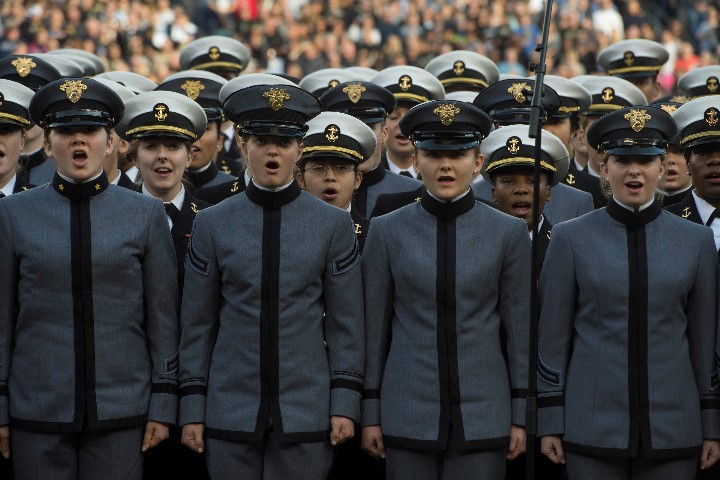
‘Changed the way I carry myself’: Students, parents tout benefits of military academy

Parents of Hargrave Military Academy graduates recently explained the reasons why they opted to send their children to the highly structured Virginia private school for boys, and it centers on one word: character.

David Renaker, whose son Corey Renaker graduated from Hargrave in 2016, told WRAL the discipline at the military academy helped to limit distractions from social media, video games and other time wasters to help his son focus on what’s most important.

“The changes that have been made in Corey are dramatic. He’s a different person. He’s respectful, prompt, cares about what’s going on, and cares about his future,” David Renaker said. “I can’t say those were character traits he had before going to Hargrave. Hargrave made a tremendous difference in his life and ours.”

The single-sex, academically rigorous environment focuses a lot on students’ post-graduation success, both by forming character strengths to help them persevere and offering more challenging courses than traditional high schools, parents said.

Researchers at the Institute for Advanced Studies in Culture contrast the prevalent views of school culture: “There is a skeptical view that suggests that tight social networks of oversight provide an ongoing surveillence over young people, giving them little room to experiment or make mistakes. The more positive construction would be that a close community provides a watchful and loving attentiveness that allows the young person to thrive.” The social ecology of a school is determinative in character formation.

“Because of Hargrave, his GPA has risen, he got a full four-year scholarship to Alabama, plus an engineering scholarship on top of that,” said Calyx Harris, whose son Hayden Bressoud graduated from Hargrave in 2017. “He found fraternity and camaraderie here at Hargrave; it’s just been a fantastic experience.”

Like many private schools, Hargrave expects students to adhere to strict schedules and rules of decorum, and stresses self-discipline. Parents and students said the structure, along with school uniforms, expected code of conduct, and other rules contribute to a sense of safety and order that’s often absent from public schools.

Shaq Lawson, a 2012 Hargrave grad who was drafted to the NFL in 2016, told WRAL he credits his success in large part to the military-style regimen.

“I believe God put me on the right path to be successful. If I hadn’t gone to Hargrave, I’d have had a much harder time adjusting to life at Clemson in my freshman year,” he said. “Going to Hargrave changed the way I carry myself. It made me more accountable, more responsible, more of a man.”

Teachers and principals working to strengthen moral and citizenship formation in their students can find information and strategies at the UK’s The Jubilee Centre.